
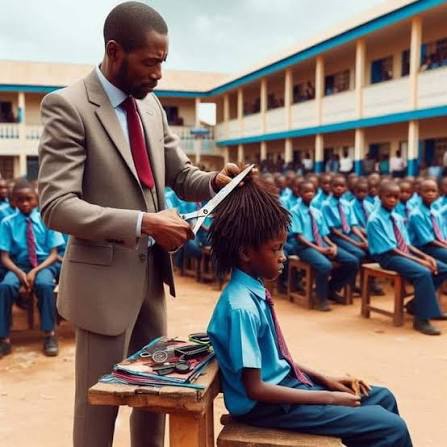
The debate over Ghana’s “no long hair” policy for Senior High School (SHS) students continues to spark controversy. Government officials argue that the policy instills discipline and fosters proper character development, yet critics maintain that it infringes on students’ cultural and personal expression. While maintaining order in schools is important, the mandatory haircut policy risks violating students’ rights, dignity, and individuality, and requires thoughtful reconsideration.
Why the Policy Raises Concerns
The rule disproportionately affects students particularly girlswho wear their hair naturally or according to cultural or religious customs. A widely circulated video showed a first-year girl at Yaa Asantewaa Girls’ SHS in tears as her long hair was cut upon admission. This incident highlights how deeply personal and emotional the issue is, far beyond the question of uniformity.
Religious and cultural freedoms are also at stake. The case of Tyrone Marhguy, a Rastafarian student denied entry to Achimota School due to his dreadlocks, underscores the tension between grooming rules and freedom of expression. Enforcing a uniform standard without accommodating diverse cultural practices risks erasing aspects of students’ identities passed down through family, tribe, or faith.
Moreover, the policy reflects a top-down, authoritarian approach to discipline. Many SHS haircut rules are not formally codified by the Ghana Education Service (GES) but are enforced at the discretion of school administrators, leaving room for arbitrary punishment and inconsistent application.
Arguments in Support and Their Limitations
Proponents claim the policy promotes hygiene, safety, and discipline. Education Minister Haruna Iddrisu has stated that schools are not venues for beauty contests, warning that relaxing the hair rules could lead to laxity in other areas, such as dress or conduct.
Another justification is that parents implicitly agree to these rules when enrolling their children in public SHSs. Counselor Frank Edem Adofoli asserts that parents understand the expectations regarding uniforms and grooming. While this logic has some merit, it does not account for the psychological distress, social stigma, or identity suppression that students experience under strict conformity.
Counterarguments and Rebuttals
Counterargument 1: Mandatory haircuts are necessary for hygiene and safety.
Rebuttal: Experts, including former Education Minister Dr. Yaw Osei Adutwum, argue that hair policies should prioritize hygiene rather than appearance or control. Long or styled hair does not inherently compromise health or safety if properly managed for instance, tied back or neatly maintained.
Counterargument 2: Strict grooming enforces order and discipline.
Rebuttal: While discipline is essential, it should not override students’ rights. Many current rules lack formal legal backing, making enforcement arbitrary. GNAT President Rev. Isaac Owusu has emphasized that any strict grooming directive should have parliamentary support to avoid misuse of authority.
Recommendations for Reform
To balance school discipline with students’ rights, the following measures are recommended:
Legal Clarity: The government should codify clear, fair grooming guidelines that prioritize hygiene and safety rather than aesthetics, ensuring administrators cannot enforce rules arbitrarily. Inclusive Policy Development: Engage students, parents, and cultural or religious organizations when creating grooming policies, reflecting Ghana’s diversity and respecting identity. Flexible Standards: Allow hairstyles that are neat, safe, and culturally appropriate rather than imposing blanket bans. Periodic inspections can enforce rules without forced haircuts. Counseling and Awareness: Offer orientation and counseling programs to help students understand policy goals while encouraging self-respect and cultural expression.
Conclusion
While the intention behind Ghana’s mandatory haircut policy may be to instill discipline, it risks undermining students’ individuality, cultural identity, and dignity. Discipline should not come at the cost of personal freedom. By legislating inclusive, lawful, and culturally sensitive grooming standards, Ghanaian SHSs can uphold order without erasing the voices and identities of their students. Schools should be spaces for growth, learning, and self-expression not strict conformity
 Justice Scripts
Leave a comment